Case / MBNA
Supporter of You
How linguistic anaesthesia disguises organisational self-interest.
Last week my credit card provider announced, with considerable enthusiasm, that my Mastercard would soon become a Visa card.
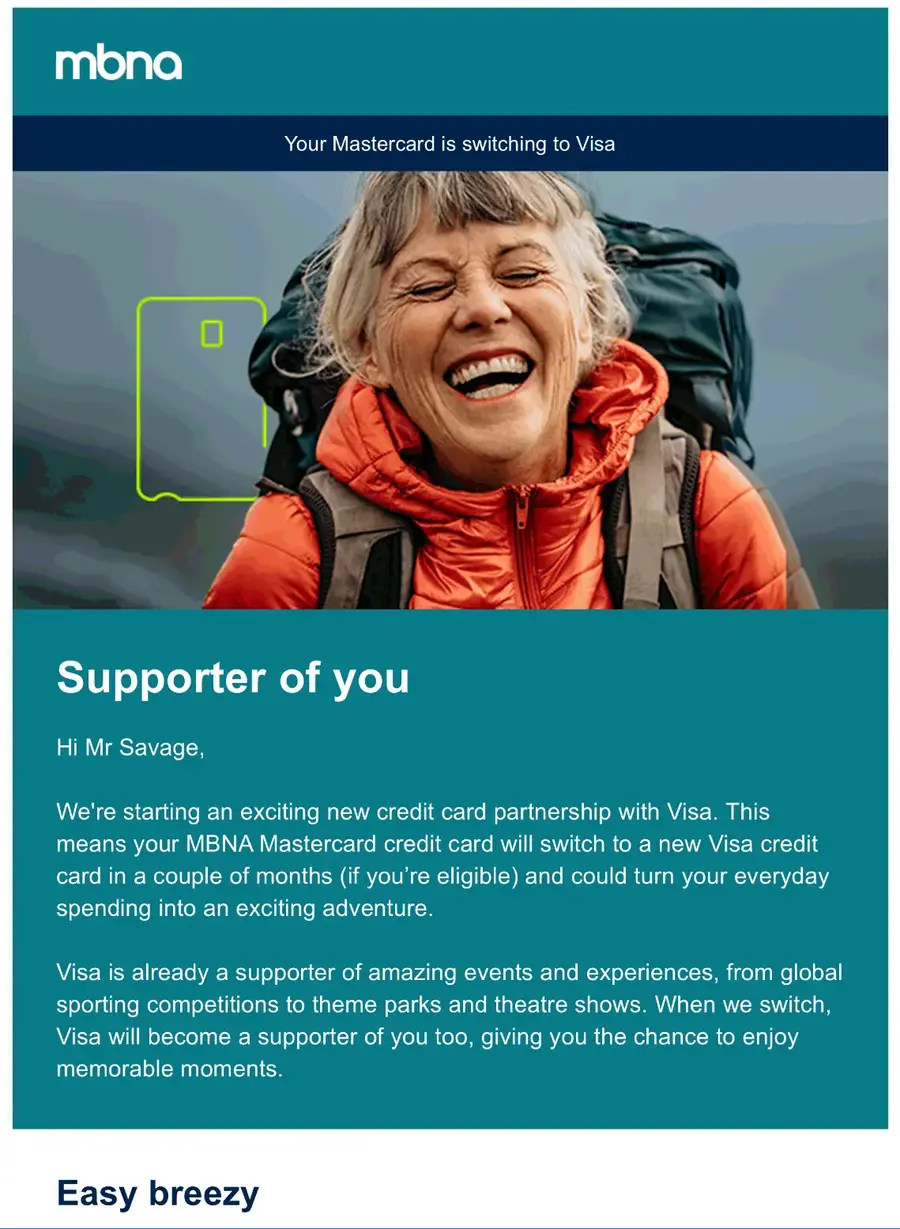
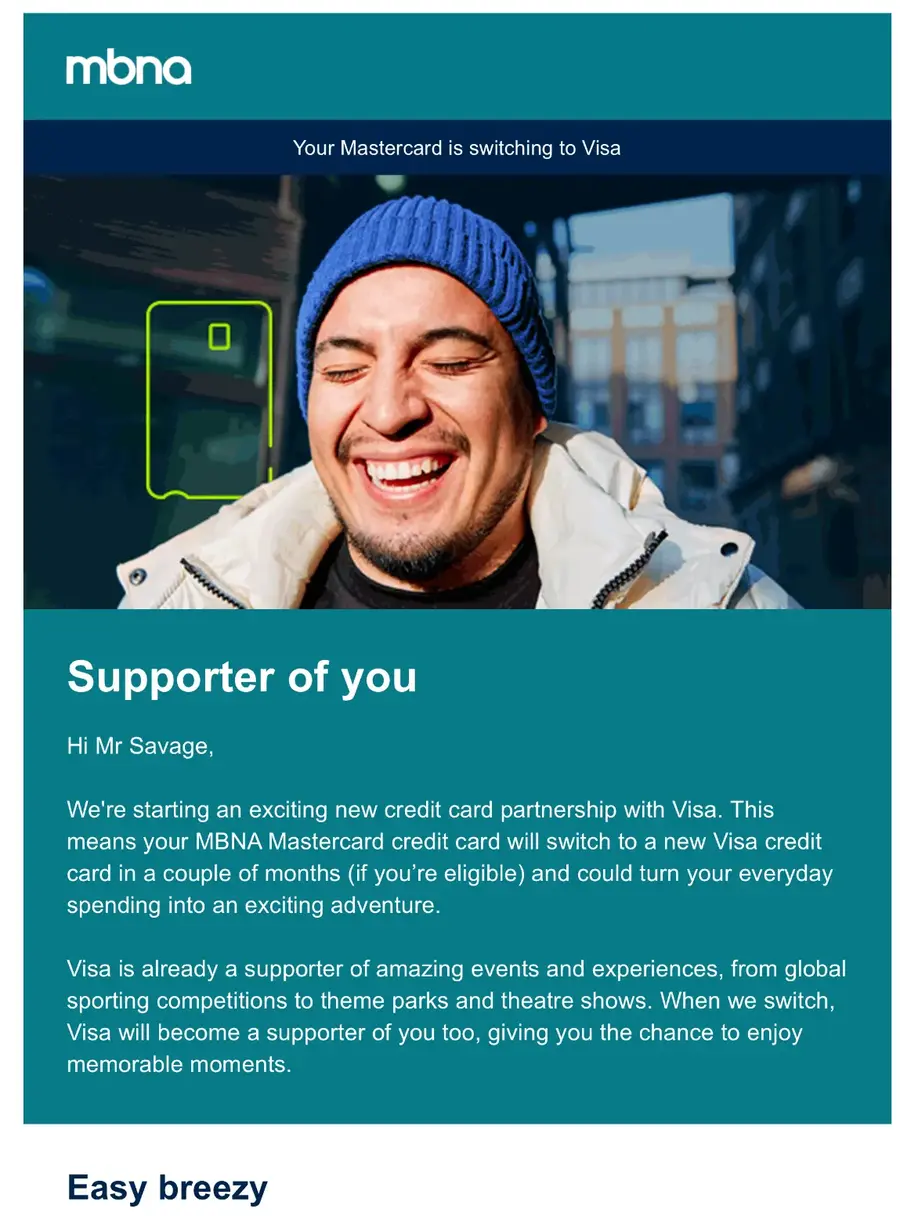
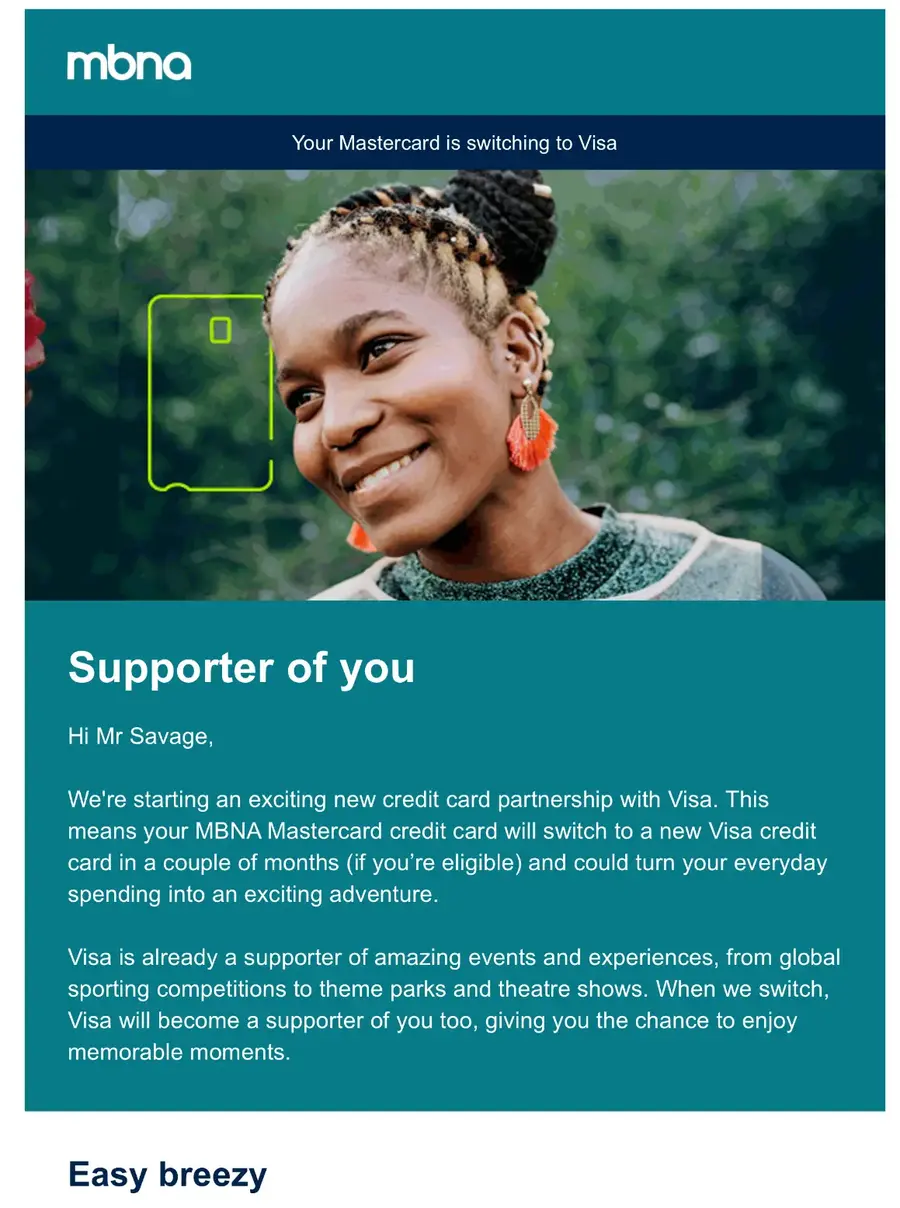
The email was remarkably cheerful. Its rotating image carousel showed a woman halfway up a mountain clearly hysterical at the news, a man laughing despite apparently having been blinded by the photographer’s flash, and another woman, with whom I entirely identified, looking rather less convinced that any of this was anywhere near as exciting as the accompanying language suggested.*
“Your new Visa card.”
“Your exciting adventures.”
“Your memorable moments.”
“Supporter of you.”
The word “your” appeared twenty-seven times.**
At first glance, it is perfectly ordinary marketing. Read it again, though, and something rather interesting emerges. The actual news is surprisingly mundane.
The bank has changed payment network.
At some point, Mastercard ceased to be MBNA’s chosen network and Visa became it. There were presumably negotiations, commercial incentives and strategic considerations behind that decision. That is entirely normal. Businesses should seek commercial arrangements that work for them.
But here’s the thing, I had no idea this decision was even being considered. Nobody asked whether I preferred Visa or Mastercard. Nobody invited my opinion. Nor should they have. It is not my business. Yet the moment the decision was made, the narrative abruptly changed.
Suddenly, this was no longer their commercial decision.
It was my exciting opportunity.
Except it was not.
It was the creation and transfer of customer labour.
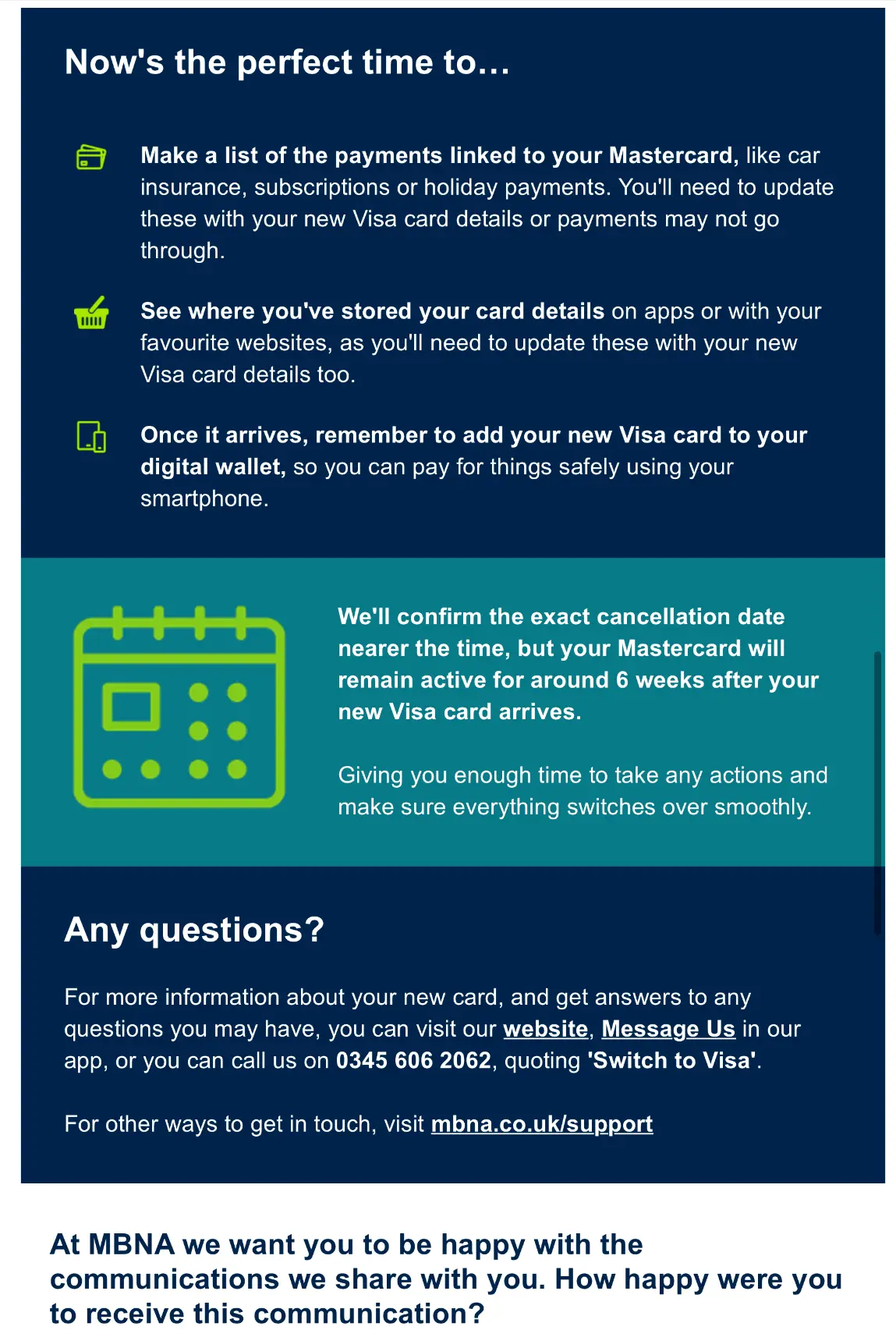
I now had to activate a new card, update online retailers, change recurring subscriptions, amend digital wallets and spend time ensuring that nothing stopped working. The implementation cost had not disappeared. It had simply been redistributed. Part of the administrative burden created by the organisation’s decision had quietly become mine.
On its own, the labour created by MBNA’s decision is minor. The problem is cumulative. Every organisation assumes it may requisition a little more of the customer’s time, then narrate that requisition as service.
Imagine your plumber writing to announce that he had switched from Makita to DeWalt.
“We’re delighted to introduce your exciting new DeWalt experience. Your future plumbing adventures start here.”
You would stare at the letter in bewilderment. No. Your plumber bought different tools. At least his news did not cost you time or labour.
Now imagine your landlord replaced every lock in the building.
“We’re thrilled to announce your enhanced access experience: new locks! Please collect your new keys, update everyone who visits you and enjoy this exciting new chapter with us.”
Again, you would recognise immediately what had happened. The landlord made a decision. You inherited the administration. You had no agency in the decision, yet you were directly affected by its implementation. New locks might represent a genuine safety improvement. That does not alter the structure of the exchange. The landlord made the decision while the tenant inherited its administration.
What an organisation should not do is present a decision made primarily in its own interests as though its purpose were primarily ours.
The analogy makes obvious what corporate language often obscures: The work remains. The agency does not. And the purpose is subtly reframed.
This is what I think of as linguistic anaesthesia.
Not language that necessarily lies. Language that gently numbs awareness of what is actually happening.
A commercial decision becomes a customer benefit.
Administrative effort becomes empowerment.
Implementation becomes adventure.
By repeatedly addressing me as “you”, the email subtly recasts me as the protagonist of a story that I neither wrote nor requested. The photographs complete the effect. They do not explain the change. They model the emotional response the customer is apparently expected to have.
Delight.
Excitement.
Hysterics?
One woman, at least, did not seem to have received the full briefing.
The fascinating question is not whether the bank was wrong to change supplier. It is why modern organisations increasingly feel the need to narrate their own business decisions as though they were gifts to the customer. Perhaps the most honest version of the email would simply have said:
“We have chosen a new payment network. This will require you to update some payment details. We recognise that some of the resulting administration will fall to you and hope to minimise the inconvenience.”
Less exciting, certainly. But arguably far more likely to increase trust.
* In fact, she looked about as convinced by the news as Gene Wilder in the famous “please, tell me more” meme.
**Before the email reached its “Any questions?” support section, the word “your” had appeared twenty-six times. Across the complete email as received, “your” appears 34 times; “you” 36 times; “you’re” three times; “you’ll” three times; and “you’ve” once. That is a whopping 77 second-person references in a single email. MBNA marketing email, “We’ve chosen Visa as our new credit card partner”, received 28 July 2026.
Images and communication extracts reproduced from an MBNA marketing email received 28 July 2026 for the purposes of criticism, review and evidential context. Copyright and trade marks remain with their respective owners.