Case / Monmouthshire County Council
Passed back to customer
How citizenship is now a customer service problem to field.
Let’s faece it*, there’s quite predictably a dog poo problem near, or possibly on, your doorstep. From urban parks to rural spaces, the issues are ubiquitous: it smells bad, it’s unhygienic, and it offers no obvious ecological benefit to the surrounding soil, pavement or ground.
It, like cat crap, can cause even the most level-headed person to become briefly apoplectic if, by some unfortunate turn of events, they step in it. Once it clings to a shoe, accompanied by that uniquely gag-inducing smell, people can become quite reasonably, a little testy.
This isn’t a story about the pervasive problem itself. Nor does it seek to vilify dog or cat owners nor claim to have found some glorious solution.
It is about what happens when you try to take one small, potentially constructive step towards solving a local concern, and how engagement with bureaucracy at local-government level can expose something much wider: the failure to own the problem, and the growing habit of fielding it instead. This is what happened in one interaction with Monmouthshire County Council (MCC), and what makes for interesting analysis is that the design choices implemented expose a wider problem about ownership, labour transfer and what institutions call efficiency.
It was a simple proposition: the installation of a dog waste bin in a location where there appears to be a persistent problem. Once one dog starts it becomes a calling card for the next. Solution: bin. Simple. Effective. Helpful. The request, with accompanying suggested location photo attached, was submitted and we all went on with our day.
About a week later a response was received advising me that dog waste was in fact dealt with by the town council and to email them instead, and they helpfully included the relevant email address. A system update email was also received proudly saying “Passed back to customer”.
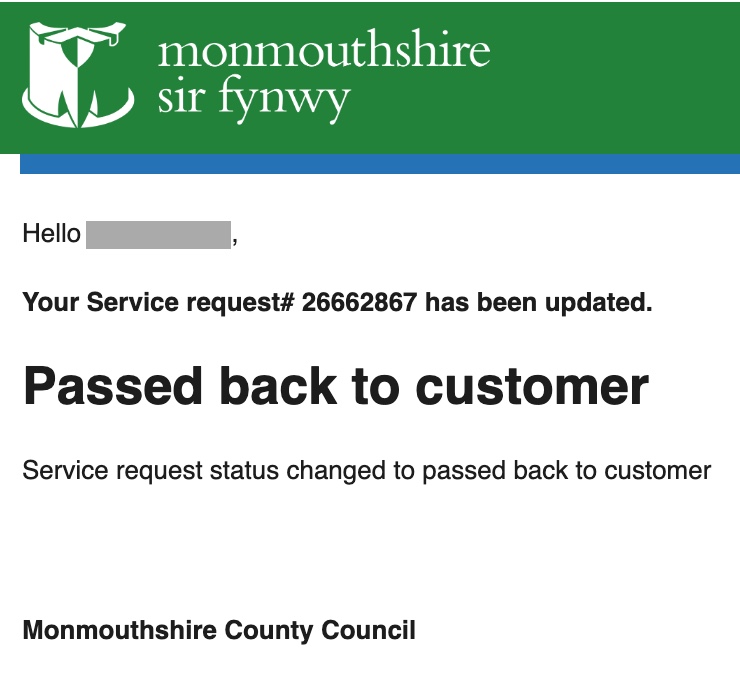
That’s when I got interested because of what it revealed:
Citizen in theory, customer in workflow, unpaid administrator in practice.
Addressing the apparent inefficiency first. You raise an enquiry on the local government website portal, it then gets routed to main County Council administration. Being that they are the administrative hub, a clear direction of travel would be to forward the enquiry to the Town’s local administrative hub, thus keeping momentum and progress moving forwards through internal routing. What happened is that instead of taking ownership of the enquiry and doing just this, it was bounced straight back to the ‘customer’ (I’ll come back to this in a minute).
Once in administrative hands, it would be reasonable to expect the enquiry to be progressed rather than deflected.
Ownership here does not mean assuming responsibility for a decision that belongs to another authority. It means owning the journey, even when you don’t own the outcome: retaining responsibility for getting the enquiry to the place where that decision can actually be made.
MCC describes its Contact Centre as the “first point of contact for all council telephone enquiries” and says it will transfer calls to the relevant department as requested. While this refers specifically to telephone enquiries, the principle is revealing: internal routing is already an established part of the Council’s own contact model. Yet in this case the online enquiry was passed back to the resident instead. This creates a clear Behaviour / Language Divergence: the stated premise is ownership; the lived experience was fielding.
The helpful and actively owned response could have been:
“Thank you for your request regarding dog waste bin installation in your area. This matter is managed by the local town council. I have forwarded your enquiry to the relevant team and provided contact details for your information. They will be in touch with you in due course.”
The reply received from the Council, whilst containing pertinent information, did not progress the enquiry. It merely fielded it. Yet with “Passed back to customer” applied as the status, the administrative interaction could still appear complete. That creates a distorted idea of success: the Council had responded to the enquiry, but had not owned it.
The workflow records completion at precisely the point the citizen inherits the unresolved work.
It also failed to provide means of reply with the now ubiquitous communications breaker:
“Please note: this is an automated email, do not reply to this email address.” **
The message creates an immediate workflow fracture. From the sender it creates efficiencies and contains communications in silos. For the receiver it creates additional administration and labour having to then identify the workable communication channel(s) available to them - often only discovered when your initial reply gets rejected by their servers.
What we have is an asymmetry of labour required to perpetuate an enquiry. A reply function usually does exist, but often requires a variety of actions: finding an alternative email address, independently logging in through a portal, completing two-factor authentication, checking an email for a password, locating enquiries and hunting down the case file.
Technically available. Practically unavailable.
Access depends upon the citizen performing investigative and administrative labour, often in excess of the value of the original proposition.
So we write using this newly discovered channel within the administrative workflow:
“Hello, thank you for your reply. I wonder, could we forward it to them directly?”’
“...Yes, you can contact them directly…”
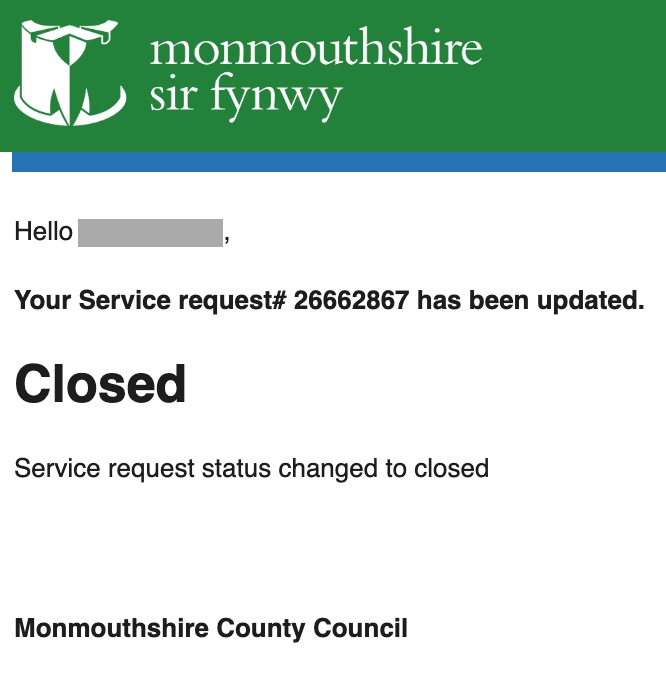
Comes back the reply. A separate follow-up message advises that the service request has been updated to “Closed”.
The default reading was for the administrator to see my reply as asking for permission to carry out additional labour, rather than as an invitation, in their capacity as administrator and handler of the enquiry, to take ownership of it and route it internally. So twice given the opportunity to own the enquiry, twice it was fielded, defaulting to an interpretation that preserved the labour with me and revealing no observable attempt to retain ownership once the correct authority had been identified. I was absolutely free to route it myself. I can contact them directly. They said so. Twice. And so administrative completion is achieved without real resolution.
The original enquiry is now back at the beginning again with the need for a new line of communication and repeat cost of labour with nothing materially progressed. Yet to the administrator they have shared an email address and told the ‘customer’ to send enquiry there, and they will see that as success. Case, as they very clearly articulated: Closed.
This ‘don’t own it, field it’ behaviour is not confined to this enquiry. It recurs across customer-service systems in which response and closure are measured more readily than ownership or resolution. Turnaround and a paper trail become evidence of productivity. Actual resolution is treated as comparatively expensive because it requires time, material or ownership.
Fielding bounces the enquiry back to the enquirer with advice to contact another person within the organisation. Whether by design or accident, it can result in attrition of enquiry, with the fielder going on record as having been productive and, arguably, presenting as helpful.
What’s pertinent in this instance is that the effort to own the enquiry would have taken the same amount of effort as was taken not to own the enquiry.
The curiosity is why. Is it simply efficiency? Are administrators being deprived of agency by the systems within which they work? What drives the abdication of responsibility rather than its uptake?
One possible constraint on owning an enquiry is data protection. That matters: personal information should not simply be passed between unrelated organisations without a lawful basis. Yet MCC’s own My Monmouthshire privacy notice explicitly states that submitted data may be shared, where necessary, with partners including town and community councils within Monmouthshire so that concerns can be directed to the appropriate service provider. It further states that, by submitting personal data through the service, the user indicates agreement to this sharing.
As citizenship becomes increasingly mediated through customer-service systems, citizens are recast as consumers of society. With that comes the language and behaviour of consumer entitlement: access, dissatisfaction, redress, indignation and complaint. Institutions, in turn, increasingly funnel almost every form of challenge, criticism or feedback into complaint processes designed to resolve individual service failures rather than engage with wider questions about how the system behaves. The citizen becomes a customer, criticism becomes a complaint, and discourse becomes case management.
It’s a serpent swallowing its tail.
An enquiry about a poo bin became a statistic on efficiency, even contributed to GDP***, yet left the enquirer having progressed nowhere and that small bit of non-progressive friction resulted in trusting the system a tiny bit less, each minor erosion of trust compounding with the last.
If we are to believe that institutional trust is an aspiration worth upholding in the shifting sands of post-truth reality could it be argued that organisations should be adopting “Own it. Don’t field it.” as a working principle? Rather than prioritising completion metrics, improved trust might reasonably follow, with fewer repeat contacts, less escalation and less duplicated labour as a consequence.
“Passed back to customer” may be a status update, but it also records the transfer of labour and responsibility to the citizen, and the trust lost in the process.
* You’re welcome.
** ‘Do not reply’ is the subject of a separate article.
*** Recorded activity is not necessarily evidence of good or desirable outcomes. A serious road accident can generate economic activity through emergency response, recovery, repairs and medical treatment, all of which contribute to GDP, despite the event itself being catastrophic. The fact that activity has occurred does not necessarily make the outcome good.
Right of reply
Before publication, Monmouthshire County Council was invited to explain the terminology used, why the enquiry had not been forwarded directly to Monmouth Town Council, and whether “Closed” meant that the underlying matter had been resolved.
The Council responded that dog-waste bins are the responsibility of Monmouth Town Council, that its contact details had been provided, and that the system subsequently marked the enquiry “Passed back to customer” and “Closed”. It described this as “standard procedure from the Contact Centre”.
The response did not address why the original enquiry had not been forwarded directly to Monmouth Town Council.
Images and communication extracts reproduced from Monmouthshire County Council service-request correspondence and its right-of-reply response for the purposes of criticism, review and evidential context. Copyright and trade marks remain with their respective owners.